








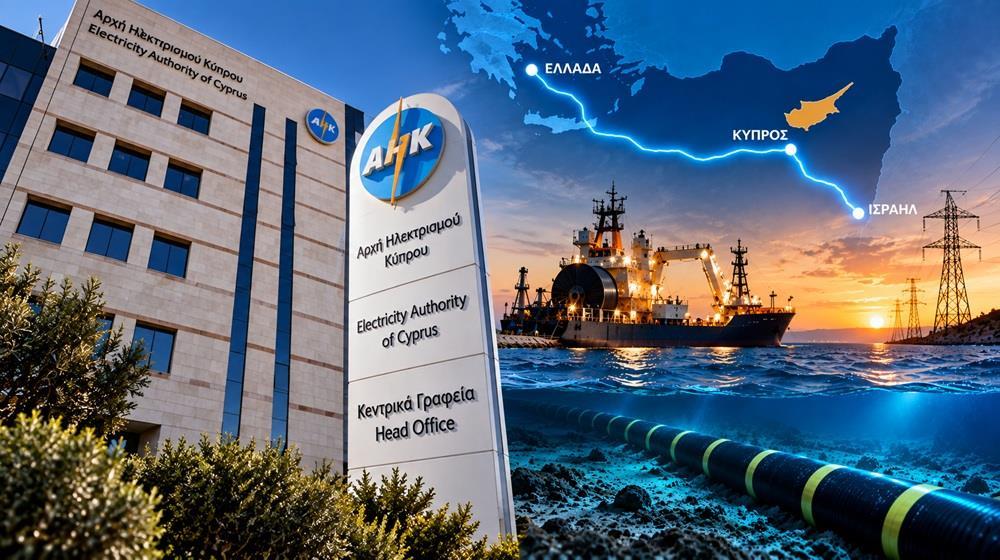
While developments surrounding the Cyprus-Greece Great Sea Interconnector (GSI) electricity interconnection are ongoing, the Electricity Authority of Cyprus (EAC) is examining the potential impacts it will have, both on itself and on the Cypriot economy more broadly, as well as on Cyprus's electricity system.
In this context, the Authority proceeded with the announcement of a tender, through the Electronic Procurement System (e-procurement), for the purchase of specialised consulting services and the conduct of relevant studies.
Based on the tender documents, which were posted in English, the focus of the study requested by the EAC is the economic impacts of interconnection on its four main regulated activities - Generation, Supply, Distribution and Transmission -, as well as the risks and opportunities created for each separately.
The contractor that will be selected will be asked - among other things - to examine revenues, expenses and profitability, but also to indicate specific actions to limit risks.
Of particular interest is the fact that the EAC is not only requesting that the Great Sea Interconnector operating scenario be examined , but also the impacts of a potential delay in the development and operation of the project, as well as the risks and opportunities from possible other electrical interconnections between Cyprus and third countries.
Market simulations until 2037
According to the documents, a central part of the competition is the simulation of how Cyprus' competitive electricity market will operate with the electrical interconnection in operation.
According to the terms, the contractor will carry out simulations for the period 2028-2037, taking into account the operation of other European electricity markets, as well as the particular technical limitations of the Cypriot electricity system.
The equation will include, among other things, the limitations of the transmission network, possible difficulties in synchronizing the Cypriot network with the submarine cable, the need to keep specific conventional units in operation for system stability, the arrival of natural gas, fuel prices and CO₂ rights, as well as targets for RES, energy storage and new technologies such as green hydrogen.
As is specifically noted, these simulations are also expected to show the market share of EAC's Generation and Supply, as well as the costs and revenues of all four activities of the Authority, data which will subsequently feed into the economic studies.
Electricity prices, blackouts and exports on the table
Based, moreover, on the tender documents, the mandate that will be given to the selected contractor is broad and touches on issues that are at the core of the discussion around interconnection.
Among other things, the EAC requests that the potential benefits and disadvantages for the Cypriot economy be captured, examining, among other things, the possibility of reducing retail electricity prices, the effects on the development of Cypriot industry, the creation of new sectors that will utilize innovative technologies, as well as the possibilities of selling electricity to third countries through exports.
At the same time, the study should examine technical, economic and regulatory implications for the electrical system. The terms of reference include the possibility of blackouts, the impact on the system's short-circuit levels, the need for reserves, the dependence of power adequacy on interconnection and ways to limit this dependence.
The possible additional production cost should also be added to the bill, such as the cost of maintaining reserve production capacity to cover a potential failure of the interconnection.
"X-ray" on EAC's revenue and profitability
The financial aspect of the tender is of particular importance. The contractor will have to prepare separate economic impact studies for Production, Supply, Distribution and Transmission.
The studies will examine historical financial data, the current financial situation and financing structure, as well as forecasts for operating costs and revenues.
The reference period will cover the period 2028-2037, while the contractor will have to prepare the cash flows of each activity based on the results of market simulations.
At the same time, four separate reports will be prepared on the risks posed by the Great Sea Interconnector to the sustainability of each of EAC's activities and the actions that should be taken to mitigate them. Corresponding reports will also record the potential opportunities that the interconnection may create and the ways to exploit them.
What happens if the cable is delayed?
A separate scenario concerns a possible delay of the Great Sea Interconnector. The EAC asks the consultant to examine the benefits and disadvantages that could arise in such a case for Generation, Supply, Distribution and Transmission.
The terms of the tender themselves mention as examples of issues to be investigated the possible increase in retail electricity prices, the need for new investments, both in production and in networks, as well as potential increases in electricity sales and revenues.
Seven packages of deliverables in three months
It is noted that the project is scheduled to be completed within three months from the start of the contract to be signed, which demonstrates the tight time frame set for the contractor.
In total, seven main deliverable packages are foreseen. These include the market simulation, the assessment of the impacts on the economy and the electricity system, four risk reports and four opportunity reports for the EAC's activities, the economic impact studies, the implications of a potential delay of the GSI and the assessment of other possible electricity interconnections in Cyprus.
The individual deliverables are scheduled from the fifth to the eleventh week from the start of the contract.
The estimated cost
It is worth noting that the estimated cost of the contract has been set at 350,000 euros, without specifying whether this amount includes VAT or not.
It is noted, finally, that, based on the timetables that have been set, offers from interested economic operators will be accepted until 11 November at 3pm.
Detailed competition documents can be found here
(Source: InBusinessNews)
