








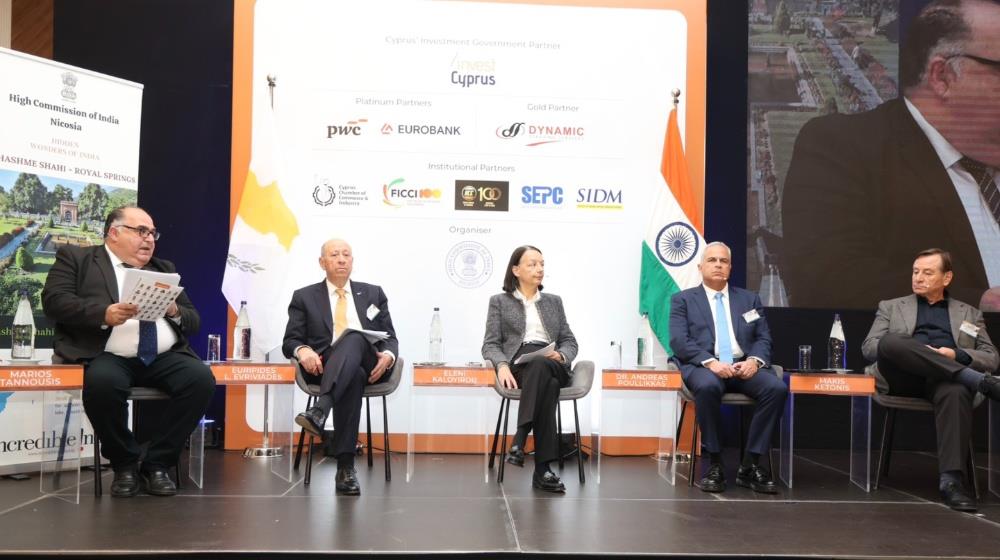
With great interest and the participation of representatives from diplomacy, academia, industry and energy organisations, the panel discussion on energy, connectivity and the green transition took place, within the framework of IMEEC, during the India –Cyprus Business & Investment Summit 2026 organised by the High Commission of India.
Frederick University Professor Andreas Poullikkas presented a research study on the interconnection of India with the European Union's internal electricity market via an undersea cable that would pass through the UAE, Saudi Arabia, Israel, Cyprus and Greece. As he stated, "we developed a mathematical optimisation model to simulate the operation of this cable", 3,730 kilometers long, which he described as an "energy superhighway". The project envisages the interconnection of 10 gigawatts of solar and wind energy, with annual flows estimated at 19.9 terawatt hours, of which 13.4 terawatt hours will end up in the EU market. According to the study's conclusions, "a 100% renewable energy corridor is feasible," with a competitive electricity price of $44 per megawatt hour and an estimated capital cost of between $15 and $25 billion.
The Honorary Ambassador of the Republic of Cyprus, Euripides L. Evriviades, stressed that “we must always put things in their proper context”, recalling India’s role in the Non-Aligned Movement and its support for the Republic of Cyprus through United Nations resolutions. He referred to Archbishop Makarios’ visit to India in 1962, noting that “Makarios took a clear position in favour of India”. He underlined that the challenge today is “to move from the past to a strategic alignment”, noting that IMEC “is a marathon and not a sprint”. He placed particular emphasis on the need for preparation, saying that “we must follow things through to the end” and ensure that the necessary infrastructure is in place in a timely manner.
The CEO of Hermes Airports Ltd, Eleni Kaloyirou, presented the company’s progress since 2006, when it took over the management of Cyprus’ two international airports. As she stated, “we delivered two brand new terminals on schedule and on budget”, which are currently being expanded to meet future needs. Passenger traffic increased from 7 to 14 million passengers, airlines from 20 to 60 and destinations from 60 to 160, while “65–70% of the traffic is inbound”. Referring to the Indian market, she noted that Hermes is “in discussions with IndiGo to start direct flights,” clarifying that “first we need to create the necessary passenger flows to make such a prospect attractive”.
The Chairman of the Cyprus Hydrogen Association, Makis Ketonis, stated that “IMEC is a real, but also a virtual corridor”, aiming to connect India with the region and Europe. He stressed that the required infrastructure is particularly extensive and “cannot be implemented overnight”, adding that the physical interconnection may not pass through Cyprus. For this reason, he proposed that emphasis be placed on the “virtual leg” of the corridor, through collaborations and joint projects, especially in the hydrogen sector. As he noted, “there can be an exchange of knowledge and information”, creating substantial benefits for both sides.
Invest Cyprus CEO, Marios Tannousis, moderated the discussion.
(Source: InBusinessNews)
