









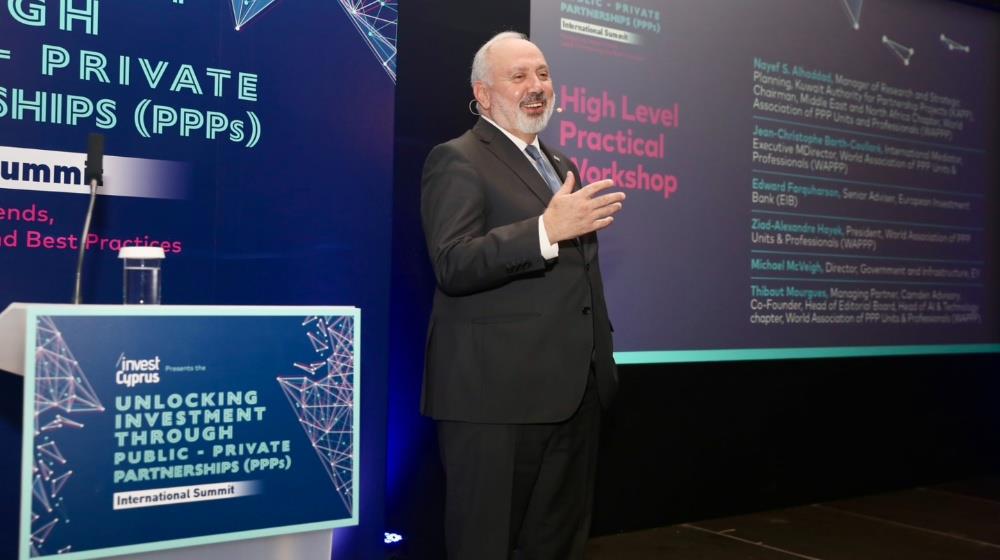
At the Unlocking Investment Through PPPs summit in Nicosia, Ziad-Alexandre Hayek, President, World Association of PPP Units & Professionals (WAPPP), offered a rigorous and, at times, candid examination of what it takes to make Public-Private Partnerships (PPPs) deliver on their promise, and why Cyprus must approach the model with more than just enthusiasm.
A publication edition containing an overview of what was discussed during the summit is now available online. You can find it here.
Contrary to the public perception, PPPs are hardly a product of late-20th-century policy innovation. Speaking on the second day of the event, Ziad-Alexandre Hayek traced their lineage back to the likes of the Suez Canal Company and even mediaeval fermage systems in France, where private actors delivered public functions in exchange for user payments. “Most operated on a ‘user-pays’ model,” he noted, a principle that underpins many modern concessions. Today, PPPs span two core models: ‘user-pays’ (e.g., toll roads, airports), where private partners recover investments from end-users; and ‘government-pays’ (PFI model), where the state pays for availability and performance over time. Both serve the same ambition – crowding in private capital and capacity to deliver public services – but they require radically different assumptions, especially about risk and return.
The real cost of private capital
As sovereign borrowing is cheaper, a question emerges: why engage private investors at all? The answer, Hayek argued, lies in ‘value for money’, a blend of efficiency gains, risk transfer and lifecycle accountability. But that’s not easy to prove. Few countries have the comprehensive data needed to run rigorous public-private comparators. “The UK might, but emerging economies often don’t,” he said, cautioning that PPP justification cannot rest solely on theoretical savings. Instead, broader benefits, like timely infrastructure delivery, service quality and taxpayer relief, must also be factored in.
Misunderstanding PPPs: A fast track to failure
Too often, said Hayek, policymakers reduce PPPs to just another procurement tool. “They are not shortcuts. If a project is urgent, pay for it. If it’s strategic, study it thoroughly and maybe do it as a PPP,” he said. PPPs demand more than project documents; they require long-term institutional discipline. From lifecycle contracting to performance-based remuneration, PPPs must be managed with clarity from design to operation. That clarity begins with a shared definition. Hayek pointed to the World Bank standard: a long-term contract for a public asset or service in which the private party assumes significant risk and management responsibility and is remunerated based on performance or usage.
Coordination against chaos
Hayek’s strongest critique was reserved for governance fragmentation. He expressed concern that various Cypriot ministries seemed to be independently launching PPP initiatives, without clear leadership from the Ministry of Finance or visible coordination with Invest Cyprus. “You cannot have four or five cooks. You need one,” he warned, underscoring the importance of a centralised PPP unit. Multiple PPP teams scattered across ministries risks project delays, misaligned strategies, and confusion for investors.
The architecture of a bankable PPP
From equity investors and EPC contractors to operators, lenders and government backstoppers, PPPs are complex ecosystems. Each component must be contractually ring-fenced to act as the legal and financial centre of gravity for PPP delivery. Risk allocation is also a delicate balance: construction, operation and financing risks typically fall to the private sector; political and regulatory risks remain with the state. “Every risk must be clearly defined in the contract. That’s what makes PPP contracts inherently complex – but also what makes them effective.”
Why PPPs succeed or fail
Hayek listed the common failure modes, including policy dissonance and weak awareness at the political level, unclear or conflicting governance frameworks, poor project preparation, rushed tenders with little market engagement and neglected local consultation, leading to community opposition. These are not theoretical risks but well-documented derailers. On the other hand, to succeed, PPPs must be integrated into national development strategies, supported by a prioritised project pipeline and designed with stakeholder engagement and local buy-in. Hayek also suggested that smaller economies like Cyprus, where mega-projects are few, should focus on small-scale PPPs. Finally, there is a need to develop a clear legal and institutional framework – not overlapping units and ministries acting independently.
WAPPP advocates for what Hayek calls “Next-Level PPP,” a model based on professional integrity, clear governance, strategic vision and transparent delivery. When PPPs fail due to corruption or mismanagement, it’s not just that project that collapses – it’s public trust in the model. “That’s why all stakeholders, public and private, must work together to protect the credibility and future of PPPs,” he told the Summit.
Read more about PPPs in the online edition here.
